

How to Get Things Done
Every single thing I know about organising work

I get asked about task management quite a lot and the process in which I follow for staying on top of my to-do’s. The truth is it is one of the practices in which I have struggled with the most throughout my life and career.
As an idea it is deceptively simple - define what needs to be worked on, compile a list and then see it through. We have a tendency to over complicate it however.
More and more I find myself thinking about how simple productivity is as a whole, and how we have become trapped into trying to overcomplicate the art of “being productive”. I have fallen foul of this trap too.
We have a glut of tools that allow us to manage our tasks and stay on top of things. There is a whole ecosystem of productivity guru’s who each claim to have the golden nugget of information that will help us become our best productive selves.
The landscape is quite overwhelming, so I understand deeply the confusion people have that lead to reaching out and asking me about how to manage tasks.
I will share the process I follow and some of the traps I have fallen into in this article. But the overarching theme is the simplest form you can get away with for being productive the better. If you take one thing away from these words, let it be that whatever you are doing right now is probably overkill. Stop overthinking and reduce the form.
History
I first stumbled across the Bullet Journal method when I spotted the book in a little homeware shop me and my wife liked to visit in Exeter. It called out to me for reasons unknown - but I knew I had to purchase it. Up until that point task management was not really something I had ever given too much consideration to. What I needed to get done, I kept in my head and then just did it when I found some time.
I bought a journal and kept this practice up for several years. I loved it and it worked. Limitations started forming however, when I noticed myself getting busier and busier. I wanted to capture tasks when I didn’t have my notebook to hand, and I wanted to store tasks for a longer period of time - things that I knew I needed to do but didn’t want to do now.
In hindsight this was my first critical mistake and it lead to a few years of pain. I flitted around all the usual suspects for YEARS.. Todoist, Things, Tweek, Notion kanbans.. You name the tool I have probably tried it.
Nothing stuck. I built systems and flows in these tools each time hopeful that this was going to be the thing that let my stay on top of all of the mountain of work that was piling up on me, but none of them lasted more than a few days.
Strangely enough, last year me and my wife were looking around a homeware shop in the Cotswolds, when I spotted a weekly spread on paper. Eerily similar to buying the bullet journal method all those years ago, I knew that I had to have it and give it a try.
Capturing tasks on that weekly spread was the first time in a long time that I was able to successfully keep up and on top of things. I kept it up for a while, but have since moved to travellers style notebook where I have a dedicated calendar notebook as well as a writing pad. I have thought a lot about what changed and why this method proved so well for me.
I don’t believe it is an analog vs digital debate specifically. What I have put it down to is you are forced to be much more intentional when you only have a limited space to capture things.
The error in moving away from the Bullet Journal method was in the fact that a digital tool made it easier to collect tasks whenever they came to my head. Whilst I thought that was great at the time, it is actually damaging.
The friction of writing something down by hand means that you are more likely to make a decision to decide that I won’t do a certain task. You limit the things that come into play and that are in your line of sight, and I think this is CRUCIAL.
My Current Flow
Each morning, I wake up make a coffee and dedicate ten minutes to writing down what needs to be done today.
This is written on paper. It’s usually four or five things that are on top of my mind. I find this is incredibly useful just to get anything out of my brain that is being held on to. The act of getting it down on to a page is both useful and meditative. If its top of your mind and you can recall it in this way, then I feel pretty confident it is important to do.
I keep a weekly list in a Raycast note, with each day of the week. After I have written the tasks down manually, I will open my Raycast note, and see what hasn’t been done from the day before and how it fits with what I wrote down.
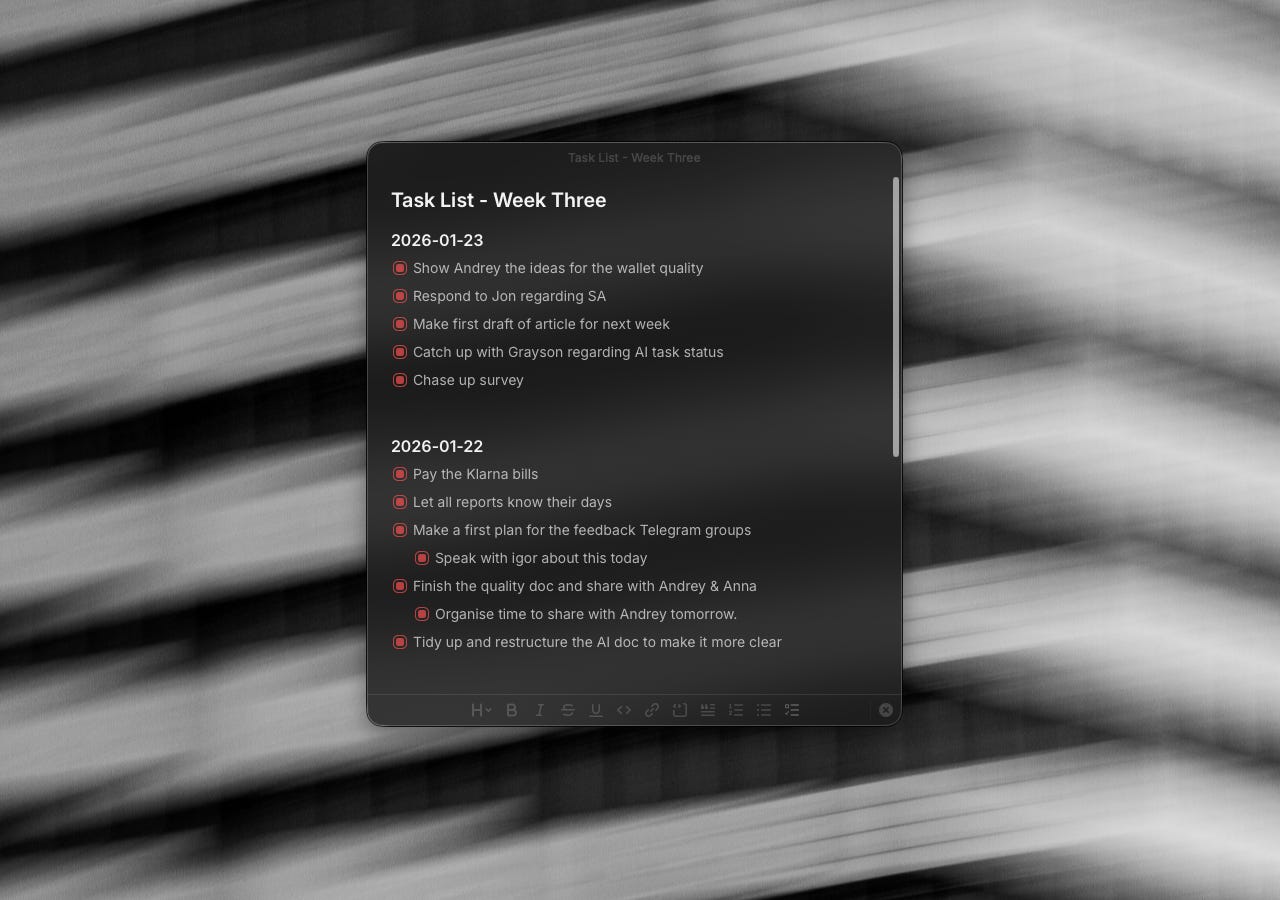
I then set a 30 minute focus session (on Raycast) and try and get as much as them done as possible without distraction. This is a super critical step for me actually - usually tasks are much quicker to do that you imagine them to be, and getting a few quick wins in first thing in the morning is a great feeling.
Anything else that is bigger, I will be sure to schedule time in the calendar for that day to getting it done. Tasks should be limited to the maximum of an hour - if it is longer than that it should be broken down.
I use Raycast notes over Obsidian (which would also work) purely for the fact that Raycast notes persists at the side of my screen when I open another window. Being consistently reminded that these things need doing and being able to see them consistently is really helpful. Sure there is a little bit of friction there, and it would probably be a bit tighter/neater in Obsidian, but I am ok with the small level of friction. In this case it is quite helpful.
One of the things I was worried about was not having the ability to write down “someday” tasks that I wanted to do at some point in the future - but I think ridding your mind of the burden of these things is healthy. I have found no downside to not having a longer time list of things that need doing. I simply decide to do it at some point this week, and if it isn’t going to be finished this week then I don’t think about it at all.
Lessons Learned
1. Simple is best - You don’t want to be spending longer than necessary or any brain space on creating a workflow to manage your tasks. The simplest form you can get away with is probably the best.
2. Removing tasks is as important as doing them - Making the decision to not do something is as important as getting things done. It stops you from focusing on the fluff, and keeps your working on the critical.
3. Get shit done - I found myself stressing and worrying about how tasks were being captured and organised more so than doing the actual work. Productivity is as simple as just doing the thing that needs to be done. If you are putting more thought into it, then you are overthinking.
4. Be honest with yourself - I knew for a long time trying these different tools wasn’t working for me, but I wasn’t honest with myself. Probably because I wanted to try and be smart and find a clever way of managing tasks. I would have saved a shit load of time had I just cut my losses and been honest with myself.
5. Make time - Having the time to look over, write tasks down and be intentional is critical. This is a step many people forget, and then wonder why things aren’t happening. At the start of each day, carve out some time to schedule your day.
6. Schedule creativity - Whilst tasks generally are something you can tick off and complete, I have found that scheduling time to “think about X” has been really beneficial. This is a very recent thing for me, but it has already proved to be incredibly valuable. It could be as simple as sitting and thinking about a topic, making some notes or mind mapping.
7. Reflect on each week - Looking back over the week and seeing how you have done is a nice practice. I often found how I have deviated from my intentions at the start of the week, and there are few things I intended to do that haven’t been done. Being aware of this, and taking it into account will only make you stronger and more efficient.
Thanks for putting words to my experience. Years of trying notions, roam, digital trackers... all to come back to pen and paper. Didn't know about Raycast, they might get a new user thanks to you.
I found this at the end of last year and it is the best daily planner I've had: https://www.mypareto.co/?srsltid=AfmBOoqiYaGZQWrrNSheEg6y6GW9bnnzI91bPrK9RWHhk4cL88NQBUxb - I have 0 affiliation, just thought you or someone that reads this would find the same joy and clarity I do.
Thanks again!
Great post! Which "travellers style notebook where I have a dedicated calendar notebook as well as a writing pad" are you using?