

How to Set and Achieve Goals in 2026
Using razors, goals and systems to achieve anything you want.

When I look back over my life, most of the things that I am particularly proud of came after a period of suffering.
At 17 years old, I was lonely and shy. I vowed to put myself out there more and speak to more people, and that year I met a girl who I eventually married and have spent 17 years with.
When I was 24 I taught myself to design websites code and landed a design/development job within a year, doubling my salary, because me and my fiancee couldn’t afford to pay our bills with my minimum wage paycheque.
Other things that are too painful/personal to talk about have inspired dramatic changes or behaviour shifts.
But of course, waiting for things to get so bad that you need to climb your way out is not very sustainable.
The last few years I have really dedicated to finding ways to push for change in my life more naturally. I have read a tonne of books on the subjects, and pulled my favourite methods from each and built a system that works really well for me.
Productivity is a simple concept, and we have a tendency to overthink it. We create these massively complex systems, that end up tripping us up or becoming redundant as our life changes throughout the year.
For me, this needed to be very simple and very minimal because at the end of the day, taking action and actually getting the thing done is the most important thing. Creating any form of complexity that doesn’t allow this to happen easily is a bad place to be in.
I have found that having a constant source of inspiration, that I can visualise (as I will go on to discuss, this is called my Life Razor) has been very useful, and motivates me in a similar way to how negative situations have spurred me on in the past.
--
There are three layers to the system that I use: razor, goals and habits/systems.
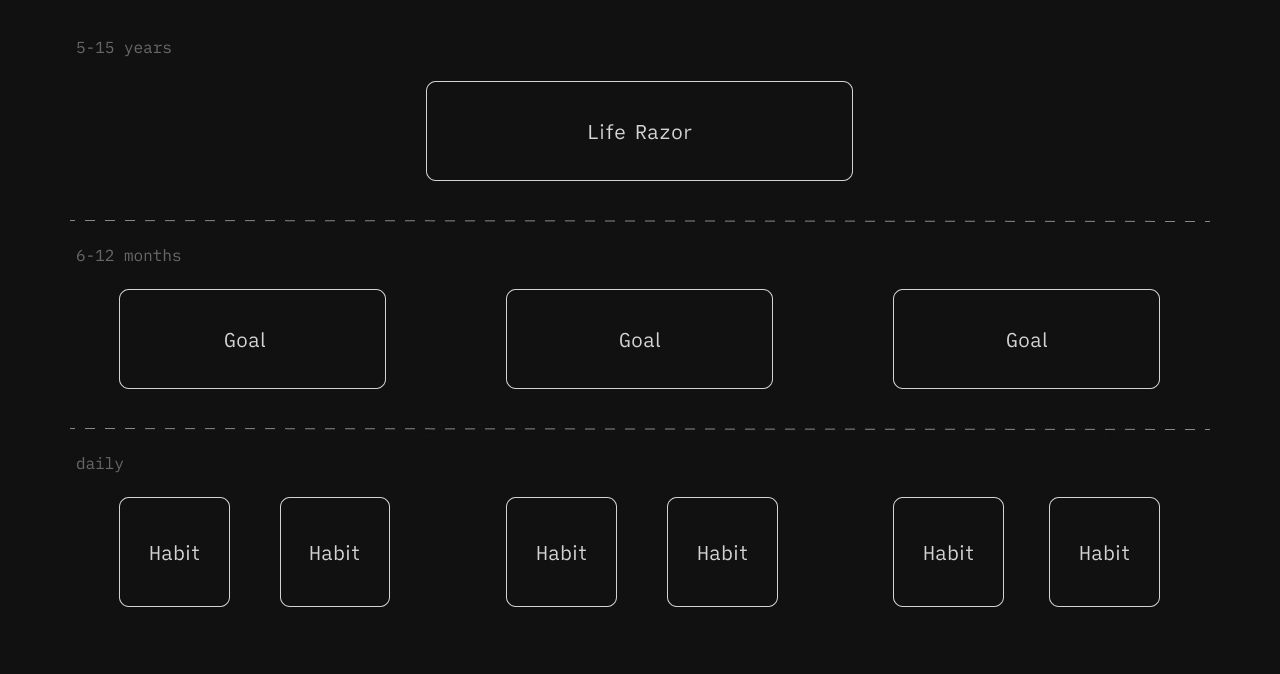
I will dive deeper into each layer below.
The Life Razor
This is a phrasing that I came across from reading @sahil bloom’s “The 5 Types of Wealth”, and it is a tidy way of describing a high level ambition or direction.
The example that Sahil gives as his life razor is: “I will coach my sons football team”. This then sets a high level direction in which he can base his future decisions around - ie, to achieve this he will need to be present for his family, he will need to have some flexibility of time, and he will need to be the sort of person who volunteers and helps out.
This concept really stood out to me, as someone who has had trouble setting long term goals specifically. It really encourages you to drive down into the type of identity you want to be as a person, and think about what truly matters in your life rather than focusing on a vanity metric and this in itself has been transformationally motivating for me.
I did a lot of soul-searching to come up with my razor, and wrote extensively about the kind of person I want to be in ten/twenty years time. The more specific the better here.
Goals
The next section is goals, and these are goals that help you specifically towards achieving your life razor.
I don’t have any specific way of setting goals - they don’t need to be written a certain way or follow any kind of time constraint. Some of the goals I have set myself will take longer to achieve than others, and that is ok - you should focus on whatever makes the most sense.
A goal should be tangible and it should be something that can be completed. If you ask yourself “is this goal done?”, you should be able to answer with a yes or no without any convolution. This is the sign of an efficient goal.
I try and time my goals roughly around the 6-12 month mark. As an example, last year I lost 20lbs over the space of 6 months, through healthy eating, daily walks and weightlifting. This was a goal that helped me towards my life razor, and I felt more motivated than ever to do it.
Habits/Systems
I am not going to try and win you round to the idea of habits/systems, because I guarantee most of the people reading this have at some point read Atomic Habits or are at least familiar with the concepts.
Marginal gains made towards your higher level goals daily are what is important here, and defining exactly what steps you need to take to make it a reality are important.
My goal last year was to lose some weight, and the habits/systems I set looked like:
“Each day I will do a 30 minute walk”
“I will lift weights 3 times a week”
“Each day I will eat in a calorie deficit of 200”
In Atomic Habits, it doesn’t really focus specifically on goal setting and James Clear advocates for a more ground up approach. I have found having an end goal, or something to aim towards has helped me largely in terms of motivation. I think this could really be a personal preference however.
Closing Thoughts
No matter how good your systems are that you put in place, they need to consistently be at the forefront of your mind. I will have visual cues dotted around the places where I need to see them the most - a post it note on the wall behind my computer, my daily habits written in my note-taking app each morning so I can cross them off. Once you have them defined, make it easy for yourself to be reminded to do them!
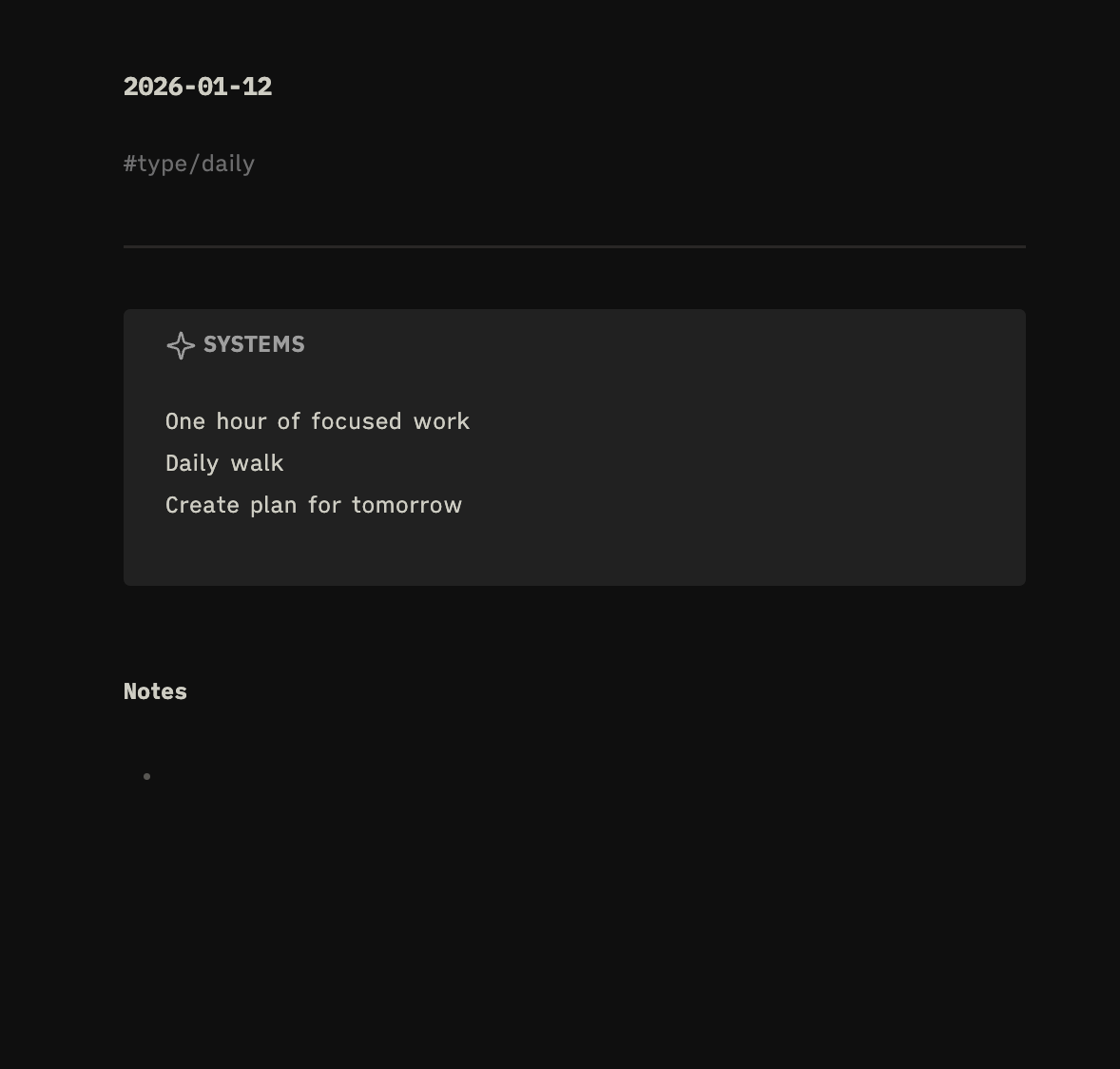
Half the battle is being specific enough with declaring the things that truly matter to you - it took me a couple of weeks to define my life-razor, and I believe that is time well spent. Don’t skimp on this part of the equation, because I believe it is the most important aspect.
“Other things that are too painful/personal to talk about have inspired dramatic changes or behaviour shifts.”
This would be very interesting to read, but I totally understand your reluctance to share it. After every crisis, I remember Nietzsche’s “what doesn’t kill you makes you stronger”, even though I’m not a big fan of his. It’s true, from my experience.